Mercedes Says Two CLA Cabins Held Up in 35 MPH Crash Test
Eight crash-test dummies recorded readings below Mercedes-Benz's biomechanical limits after a hybrid CLA Shooting Brake struck an electric CLA. The automaker says both cabins stayed intact and the electric car's battery was undamaged.
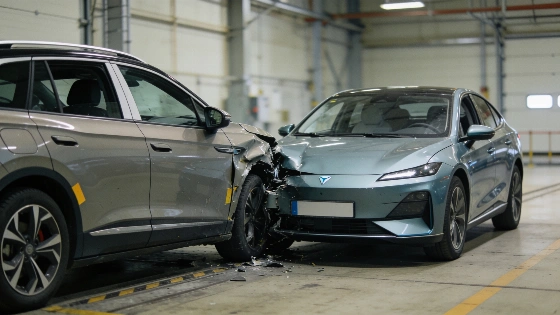
Readings from all eight crash-test dummies stayed below the biomechanical limits Mercedes-Benz uses to assess occupant protection. The dummies represented four adults and four children seated in different positions across the two cars.
The test also put the electric CLA's high-voltage battery in the path of a direct side impact. Mercedes-Benz reported that the pack remained intact with no cell breach, while the high-voltage system disconnected automatically when the cars collided.
Two moving cars in a side impact
A hybrid CLA Shooting Brake struck the driver's side of a fully electric CLA at 56 km/h (35 mph). Both vehicles were moving. Neither driver braked; each car weighed more than 2,000 kg (about 4,400 lb).
The setup recreated a T-bone collision at an intersection, with the cars meeting at a 90-degree angle. Mercedes-Benz staged the public demonstration in Stuttgart on October 20, 2026, describing it as the first public high-speed side-impact test involving two moving production vehicles. The automaker said the 56 km/h speed represents the upper end of typical intersection crashes.
Both passenger compartments remained intact, according to the automaker. Jörg Burzer, Mercedes-Benz's chief technology officer for development and purchasing, said: "Mercedes-Benz's ambition is to build the safest vehicles in the world," calling the test "a powerful demonstration of that ambition". The company presented the event as a demonstration of its approach to real-world crash scenarios, rather than a mandatory certification test or an independent Euro NCAP rating. Standard consumer and regulatory tests typically use a moving barrier striking a stationary vehicle; Euro NCAP does not currently require a side-impact test between two moving production cars.
Part of a wider safety program
Paul Dick, Mercedes-Benz's director of vehicle safety, connected the demonstration to the company's "Real-Life Safety" approach, which feeds lessons from real crashes into vehicle development. Since 1969, the company says, it has reconstructed roughly 6,000 real-world accidents.
Mercedes-Benz says it conducts around 150 physical crash tests and roughly 15,000 crash simulations for every new model. The public collision added a crossing-crash scenario in which both vehicles were moving, unlike the stationary-car setup used in typical barrier tests. The automaker's official test description sets out the demonstration and its safety-development approach.
Topics: