CATL Targets 2,000 Electric Truck Swap Stations by 2027
CATL says its Qiji system is designed to replace a depleted heavy-truck battery in about five minutes as the company targets 2,000 stations in 2027 and 10,000 over the longer term.
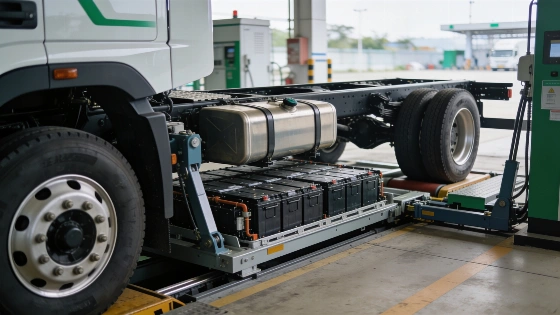
CATL says the long-range configuration of its Tianxing II platform carries 760 kilowatt-hours and can support more than 600 kilometres of driving under specified conditions. The company presented the new heavy-truck battery solutions on October 20, 2026, alongside plans to expand Qiji, its automated battery-swapping network in China, as Reuters reported. Tianxing II includes battery options designed for different truck configurations, including lighter and thinner packs that can be mounted low in the chassis.
The Qiji swap is designed to take about five minutes, a figure CATL gives as a system specification. At a station, an automated mechanism removes a truck's depleted battery and installs a charged replacement.
A network built around fast battery changes
According to Reuters, CATL is targeting 900 heavy-truck swapping stations in China by the end of 2026, followed by 2,000 in 2027. Yang Jun, CATL's head of battery swapping, said the company's longer-term ambition is 10,000 locations. An industry review by Sinosoon reported that CATL had 1,325 swap stations in China at the end of 2025, including 305 serving trucks, and described a 1,250-kilometre corridor between Chengdu and Wuhan along the Shanghai-Chengdu Expressway.
CATL's standardized modules are intended for compatible heavy-duty models developed with multiple vehicle manufacturers. The company says the approach could help fleets reduce downtime on long-distance routes and at ports. The network is meant to address charging downtime on long-haul routes, where station coverage along freight corridors is essential to keeping vehicles moving.
Swapping could also separate battery costs from the truck purchase. Depending on the commercial arrangement, freight operators may be able to buy or lease a vehicle without paying the full upfront cost of its battery. CATL says the new standardized modules have 52% fewer components and cost approximately 15% less than previous designs.
Performance claims meet infrastructure demands
Those figures come from CATL. Actual range and battery performance will depend on conditions such as vehicle weight and climate. Operating savings will also vary with electricity prices and station availability.
The network plan follows an infrastructure announcement CATL made in May 2025, when it outlined battery-swapping coverage for major freight corridors across China. In a separate report, Reuters said China aims to raise electric vehicles to 40% of new heavy-truck sales by 2030. Swapping could help address the time required to recharge large truck batteries, though expansion will require substantial investment and reliable electricity supplies. Agreements among manufacturers and energy providers will also need to work for transport companies.
CATL has announced a preliminary collaboration with DHL Group to explore electric-truck freight corridors in Europe. In July 2026, it announced an agreement with J&T Express to support battery-swapping solutions for more than 5,000 heavy-duty trucks.
Topics: