Batam Water Protests Shadow Data Centre Expansion
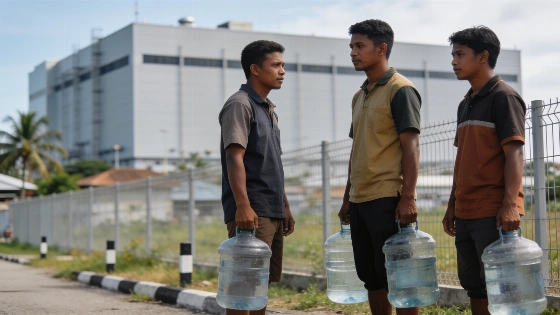
At Bakau Serip, Dewi Susanti says her household now depends on tanker trucks for water. About 300 residents gathered at a data centre compound on 5 October, carrying empty bottles and jerry cans. The protest took place outside Nongsa Digital Park after months of unreliable service, according to BBC Indonesia's protest report. Residents questioned how the island's scarce water is allocated while facilities at the park continued operating.
A separate estimate for Nongsa Digital Park puts water demand at about 29 million litres a day and electricity demand at roughly 285 MW. Wider projections for the planned data-centre complex range from 20 million to 50 million litres of water daily.
Water shortages meet expanding data centre plans
Batam's 1.3 million residents depend on rainwater stored in six artificial reservoirs. The island has no natural freshwater sources. A prolonged dry spell has put the reservoirs under greater pressure and may be linked to a historic "super" El Niño. Akar Bhumi Indonesia, a local environmental non-profit, said its simulations suggest Nongsa reservoir could dry up within a month if no rain falls.
The shortage has reshaped household routines. "Money that should be used to buy rice is now spent on water drums," Dewi said. Her husband, she added, waits overnight to collect water before going to work.
Authorities deny household water is being redirected
BP Batam, the agency overseeing trade and industry, blamed the shortages on the dry spell and denied residents' claims that water meant for homes was being channelled to data centres. BP Batam chief and Batam Mayor Amsakar Achmad said the Nongsa Reservoir's level had fallen by about 4.5 metres amid low rainfall and El Niño conditions. He added that some data centres were not yet operating at full capacity. The island's water utility told the BBC it was working to improve supply but did not say whether data centre demand was connected to the disruptions. It referred questions about the latest protest to earlier statements.
BP Batam said the Nongsa Reservoir's decline was linked to low rainfall and El Niño conditions. As a short-term measure, it reported plans to route water from a reservoir near Kebun Raya Nongsa into Nongsa Reservoir through a connecting pipeline.
After protests in August and September, authorities told companies opening data centres in Batam to build desalination plants rather than draw freshwater from reservoirs. BP Batam has also said operating data centres in Nongsa get cooling water through the Kabil Industrial Estate system, which has its own water-treatment facilities, not directly from the household network. Planned seawater reverse-osmosis plants in Nongsa SEZ and Kabil are expected to add about 750 litres per second in the first phase within two to three years. A later phase is expected to raise that figure to around 1,000 litres per second, according to ANTARA's desalination report. Indonesia's Minister of Transmigration said data-centre needs should be met without reducing reservoir reserves for residents. The amount of water and electricity used by the island's facilities has not been disclosed.
That missing figure matters. Data centres use water in cooling systems that prevent servers from overheating. Research in the United States puts a typical facility's consumption at about 300,000 gallons a day, roughly the amount used by 1,000 US households. Malaysia's central bank has cited a 50MW facility as potentially using as much water as 2,200 households and enough electricity for 22,000 homes. Those figures do not establish the consumption of Batam's centres.
Authorities have approved 10 data centres in Batam, including six planned for Nongsa Digital Park. Two are operating. Construction is under way on a third. BP Batam said at least six more applications are under review.