NASA spacecraft faults stalled Perseverance science and put Odyssey at risk
A backup-radio power shortfall left Perseverance using a slower X-band connection while a reaction-wheel problem threatened 2001 Mars Odyssey; the supplied account does not specify the year of either incident.
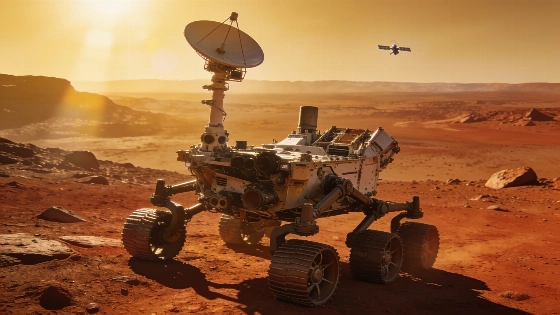
When one of 2001 Mars Odyssey's remaining reaction wheels stopped spinning, the orbiter entered safe mode and stopped sending science data. NASA said the episode occurred between November 4 and 6, 2026. A test command later moved the suspect wheel, but engineers were still checking whether they could recover it. Odyssey was out of safe mode by NASA's November 19 update, though its science operations remained offline as engineers analyzed telemetry. If the spacecraft had to rely on its hydrazine thrusters for orientation without reaction wheels, NASA estimated it had only one to two months of fuel remaining.
Odyssey had already lost one of its four reaction wheels in 2013. Three are needed to orient the spacecraft; without them, it must use its thrusters. The orbiter reached Mars in October 2001 to search for water and ice. A mission planned to last two and a half years was extended for a quarter of a century. NASA's November 19 mission update said the reaction-wheel issue had temporarily shut down non-essential systems, including Odyssey's science instruments.
Odyssey's role in Mars communications
Odyssey was part of NASA's Mars Relay Network. It sent back the first post-landing images from the Phoenix lander. It relayed images from Spirit and Opportunity, then did the same for Curiosity. NASA's historical account says about 90 percent of rover data had been relayed via Odyssey, which passed over each rover twice daily. That figure describes the network's earlier role, not the current share of Perseverance traffic.
Rovers send data over a UHF link to an orbiter passing overhead. The orbiter can then forward it to Earth over an X-band link and through the Deep Space Network. NASA has described Odyssey's relay as a "bent pipe" system. Mars Reconnaissance Orbiter and ESA's Mars Express also provide relay capability. NASA's Mars Science Laboratory landing documentation identified Mars Express as a backup relay asset if NASA's relay orbiters became unavailable.
If Odyssey could no longer relay data, Mars Express (MEX) and Trace Gas Orbiter (TGO) could take on some of its work. A former ESA insider described MEX as a science mission with relay capability, while TGO is a relay mission that also conducts science. NASA says TGO already sends the most relay data from Mars to Earth.
Perseverance falls back to a slower link
Perseverance's main computer detected a problem with its primary radio on October 30, 2026: expected "heartbeats" from the device did not arrive. The rover missed 25 electronic pings over roughly 100 seconds. Its fault-protection system powered off the unresponsive radio, switched to the redundant radio and placed the rover in safe mode, disabling non-essential systems. NASA described the incident in its mission update.
Engineers brought the rover out of safe mode and found that the backup UHF radio was transmitting at about half its expected power. The UHF radios support communications with orbiters passing overhead; the issue did not mean Perseverance had lost all ability to communicate with Earth. At the time, the rover was communicating with Earth over X-band through its high-gain antenna, a connection with a significantly lower data rate. NASA paused science and instrument operations while engineers investigated both radios. Perseverance also has two main flight computers, one active and the other serving as a backup, as described in NASA's Mars 2020 press kit.
The distinction between a slow response and a failed component matters in everyday tech support, too: a stalled Defender scan guide recommends checking whether a scan is still running before restarting it. For Perseverance, engineers said the next step was to restore the backup radio, then address the primary.