
Stellar evolution rewrites the night sky
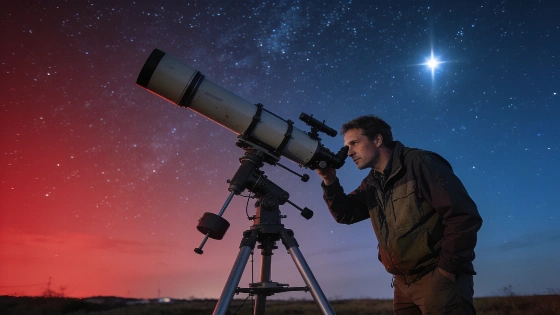
Some stars go out with a bang. When a massive star runs out of fuel, it collapses and explodes as a supernova. What's left is a neutron star. These objects cram more mass than the Sun into a ball the size of Manhattan. You can't see them with your eyes. But they spin fast and create magnetic fields trillions of times stronger than anything on Earth.
Brown dwarfs occupy a unique niche between planets and stars, with masses too low to sustain hydrogen fusion but high enough to briefly fuse deuterium.
The main sequence and its outliers
Most stars, including the Sun, spend most of their lives fusing hydrogen into helium. This is the main sequence. Fusion pushes outward. Gravity pulls inward. The two forces balance. Main sequence stars range from a tenth to 200 times the Sun's mass. Some shine for millions of years. Others last billions. The brightest, like Sirius and Alpha Centauri, are easy to spot at night.
But not every object in a stellar nursery becomes a true star. Brown dwarfs have between 13 and 80 Jupiter masses. They never start steady hydrogen fusion. A textbook excerpt on star formation says brown dwarfs fall below the 0.075-0.08 solar mass threshold for stable hydrogen burning. We mostly find them in the infrared. They blur the line between planet and star. Brown dwarfs show how messy star formation can be. Even the best backyard telescopes can't spot them.
From giants to ghosts
Stars less than eight times the Sun's mass swell into red giants when they run out of hydrogen. The core shrinks and heats up. Helium fusion starts. The outer layers puff out and cool. Giants like Betelgeuse and Antares pulse and shed their atmospheres. What's left is a planetary nebula and a white dwarf. White dwarfs are Earth-sized but incredibly dense. A teaspoon of their matter weighs more than a truck. They cool for billions of years. Some are surrounded by dust from their past lives.
Recent observations using the FAST radio telescope reaffirm that neutron stars are ultra-dense remnants of massive stars, typically about 20 kilometers across, with masses often exceeding that of the Sun and exhibiting rapid rotation.
What stargazers can and cannot see
Main sequence stars and red giants are the easiest targets for skywatchers. Sirius, Arcturus, and Gamma Crucis are all visible without a telescope. White dwarfs and red dwarfs are too dim for the naked eye. A telescope can reveal a few, like Procyon B or Lalande 21185. Neutron stars and brown dwarfs stay hidden. Only advanced instruments can detect them. We know they exist from indirect clues and special observations.
Stars come in many forms. Each has its own life, brightness, and ending. These differences shape the sky and the universe itself. Stars move from main sequence to giant, from explosion to remnant. This isn't just trivia. Stars create elements, seed new planets, and decide what we see from Earth. If you want to understand astronomy, you need to know how stars live and die. That's the heart of the cosmos.