
UP Xtreme PTL Edge Air ditches fans for solid-state cooling in Mini PC first
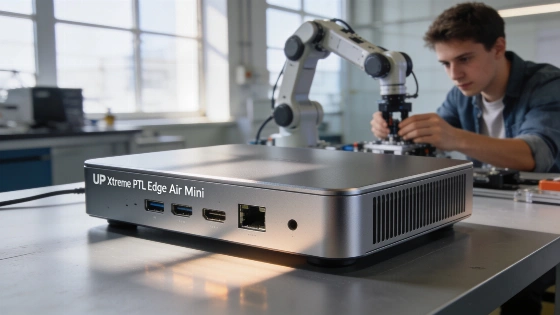
AAEON just changed the Mini PC game. The company's new UP Xtreme PTL Edge Air doesn't just shrink the box. It scraps fans entirely. This is the first UP Xtreme to use Frore Systems' AirJet solid-state cooling. No spinning blades. No fan noise. Just a new way to move heat off the board.
Intel confirms that the Core Ultra Series 3 processors used in the UP Xtreme PTL Edge Air are based on the Panther Lake architecture and manufactured using the advanced Intel 18A process node.
There's more than just a smaller shell. No fans means no vibration from spinning parts. The UP Xtreme PTL Edge Air runs at under 21 dBA. That's nearly silent. Robotics controllers, sensors, and cameras can work without extra shake. Less vibration means better precision. That's critical for robots and machines that need stable readings. It matters in the field.
Inside, buyers can pick from three chips: Intel Core Ultra X7 processor 358H, Core Ultra 7 processor 356H, or Core Ultra 5 processor 325. All are from the Panther Lake-based Intel Core Ultra Series 3. An official Intel announcement says these chips are built for thin, light devices. The UP Xtreme PTL Edge Air is one of the first edge systems to use them. The specs are strong: 12 Xe-core Intel Arc GPU, Intel NPU 5.0, and up to 180 TOPs of AI performance. The trade-offs? Power use goes up by 6%. The operating temperature range narrows to -10°C to 45°C. All the ports from the last model stay: four USB (two USB 4.0 Type-C, two USB 3.2 Gen 2 Type-A), dual 2.5GbE LAN, two COM (RS-232/422/485), two HDMI 2.1, and two DP 2.1 via USB Type-C. You can run up to four displays at once. Expansion is simple: two M.2 2280 M-Key slots for NVMe, one M.2 2230 E-Key for Wi-Fi, and the 40-pin GPIO stays put.
AAEON positions the UP Xtreme PTL Edge Air as a platform for edge AI and robotics, emphasizing the importance of reduced size, weight, noise, and vibration. The company highlights the move away from fans in favor of AirJet technology to ensure quieter and more stable operation in demanding environments.
AAEON is betting on a new standard for edge computing. The UP Xtreme PTL Edge Air is slimmer, lighter, and quieter. It keeps all the I/O and AI muscle. Solid-state cooling isn't a gimmick here. It's a fix for the real headaches that integrators face in robotics, healthcare, and embedded AI. If buyers respond, fan-based cooling in compact edge systems could be on the way out. This could set a new bar for Mini PCs in the field.