iPhone Duo Uses iPhone 17-Class Rear Camera Hardware
WekiHome's teardown finds an iPhone 17-sized main camera sensor and the same ultra-wide sensor used in iPhone 17 and iPhone 18 Pro. The inner selfie camera's listed output is far lower than the outer camera's.
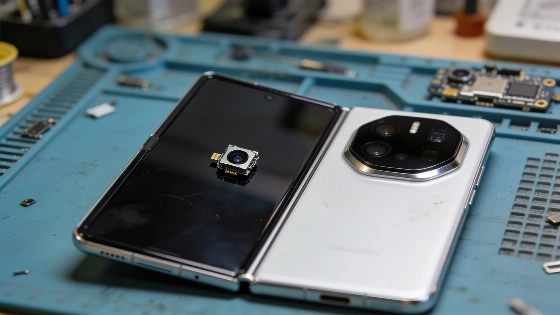
WekiHome's teardown chart lists about 4.44MP of actual image output from the iPhone Duo's inner selfie camera, despite its sensor having up to 24MP of native pixels. The outer selfie camera also has a 24MP sensor, but its listed output is 12MP. SMHN reported on October 25, 2026, that WekiHome's teardown identified Sony sensors across all four cameras, including the two distinct front-camera modules.
That gap matters for anyone expecting the under-display camera to match the outer camera for detailed selfies. WekiHome describes the inner camera as mainly suitable for video calls; the teardown documents hardware, not a controlled image-quality test. SMHN also reports that the Duo's outer and inner selfie sensors differ from the IMX914 front-camera sensor attributed to iPhone 17 and iPhone 18 Pro models.
Rear cameras are closer to iPhone 17 than Pro
The Duo's main sensor is Sony IMX954 with a 1/1.59-inch optical format. SMHN's teardown report says it reads up to 51MP natively and outputs 48MP, with an ƒ/1.6 lens, 26mm-equivalent focal length and sensor-shift stabilization. iPhone 17 uses IMX904 in the same general size class; its listed main-camera specifications include 48MP output, ƒ/1.6, 26mm equivalent and sensor-shift optical stabilization. iPhone 18 Pro and Pro Max use the larger IMX905 at 1/1.3-inch. Duo also has the first-generation sensor-shift stabilization arrangement identified in iPhone 17. The sensor names differ, so the shared size class does not establish identical readout or processing.
A larger sensor can offer more light-collection potential, but the lens and image processing also affect results. WekiHome did not conduct a controlled low-light comparison. The Duo's ultra-wide camera uses Sony IMX972, with a 1/2.55-inch optical format, 51MP native readout and 48MP output, alongside an ƒ/2.2 lens and 13mm-equivalent focal length. SMHN identifies the same IMX972 sensor in iPhone 17 and iPhone 18 Pro / Pro Max. Retail specifications for iPhone 17 likewise list a 48MP ultra-wide camera with a 1/2.55-inch format, ƒ/2.2 aperture and 13mm-equivalent focal length.
The teardown lists four Sony sensors. Its rear-camera figures distinguish native pixel counts from producing output resolution:
- Main: IMX954; 51MP native and 48MP producing results; ƒ/1.6; 26mm equivalent; first-generation sensor-shift optical image stabilization.
- Ultra wide: IMX972; 51MP native and 48MP producing results; ƒ/2.2; 13mm equivalent.
- Outer front: IMX915; 24MP native and 12MP actual output; ƒ/2.2; 23mm equivalent.
- Inner front: IMX916; 24MP native and about 4.44MP actual output; ƒ/1.8; 22mm equivalent.
The fractional-inch values are optical-format labels, not literal chip-width measurements. Apple lists iPhone 17's front camera at 18MP, a separate figure from the teardown's sensor chart.
The display changes what the inner camera can capture
Light reaches the inner camera through the display. Under a microscope, WekiHome found larger openings and a more open light-transmitting region than in the RedMagic 12 Pro+, alongside lower local display-pixel density above the camera. The pixel-density observation describes the screen, not the sensor.
WekiHome proposes that this arrangement may contribute to large color patches in Duo selfies; the microscope images do not prove the cause. Larger openings can help light pass through, while lower display density affects the screen's appearance. A larger square sensor cannot remove the optical effects of shooting through the display.
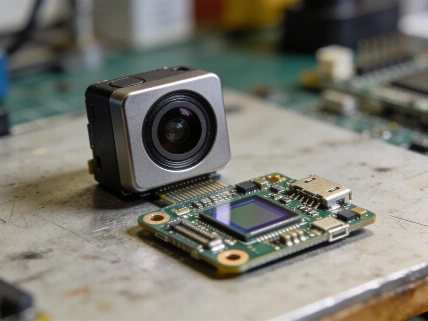
The outer front-camera assembly measures 3.29mm thick including its protruding lens. Its sensor sits in a hollowed center of the substrate, with gold wire bonding around the edges. The inner assembly measures 6.15mm at its thickest point and uses space beneath the rear camera bump. These are different module designs; the thinner outer unit still has the higher listed image output.
Video options and the teardown's other findings
Apple's Duo specifications list basic-camera 4K Dolby Vision recording up to 120 fps, compared with up to 60 fps on iPhone 17. The 2× optical-quality setting uses the basic camera rather than a separate telephoto module. The outer front camera records 4K video up to 60 fps; the inner camera records 1080p at 30 or 60 fps. A 1080p frame contains about 2.07 million pixels, so that video specification does not mean each frame is a 4.44MP image.
For a more detailed selfie, the outer camera offers higher listed output; the rear cameras can also be used with the outer screen as a viewfinder. Readers considering the foldable's everyday usability can also consult this Duo app orientation guide.
WekiHome also describes a one-piece cold-sculpted camera-bump design with precision milling, thick dust-sealing foam around the rear cameras and both rear cameras held in one metal cage. The flash has rear ambient-light sensing, and its LED unit is smaller than iPhone 18 Pro's. WekiHome counts four microphones and says they are smaller than the Pro series' units.
For rear-camera hardware, the teardown puts Duo near iPhone 17: it shares the basic sensor's size class and the IMX972 ultra wide. Its inner under-display camera has substantially lower listed actual output than its outer selfie camera.
Topics: