Eglantine Reports Full-Speed Mario Kart World With Rendering Problems Still Open
Eglantine says Mario Kart World can reach full speed on some PC setups, but no standardized frame-rate results have been published. Fixes merged in late October address an AMD shader glitch and a failure to restart after an interrupted cache save.
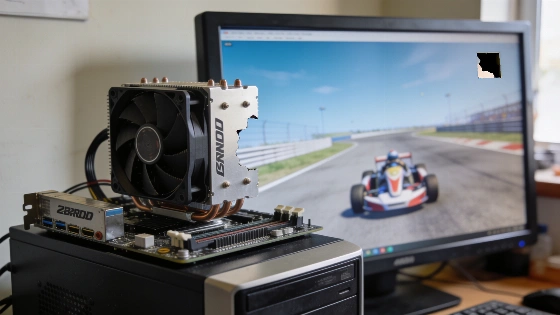
On October 31, Eglantine merged a fix for a shader glitch that produced colored bands on AMD graphics cards. The change targets one confirmed rendering bug; it does not establish that Mario Kart World now renders correctly across AMD hardware or that the emulator is stable in extended play.
That caveat matters because Eglantine's README describes the game as running at good or full speed depending on PC performance and settings, without publishing the hardware used or average and minimum frame rates. A game can process at its intended speed while parts of its 3D world fail to appear. Eglantine's settings documentation says Mario Kart World presents frames on a 60 Hz vsync event; its speed-limit setting changes presentation pacing, not the game's underlying clock.
What the full-speed claim establishes
Eglantine has no published results from standardized testing across courses, and a compatibility list is planned. A separate pre-release of Eglantine-MKW dated October 30 reports that demanding courses can fall below 60fps. It also notes brief stutters the first time a course runs. Those findings come from separate projects and do not represent a shared comparison. A separate recording shows a three-lap race at 60 FPS on Eglantine build 79, using an RTX 4070 SUPER, Vulkan, 1× resolution and frame generation disabled. The uploader describes it as a test of one race, not a benchmark of every track.
Eglantine is open source and builds on the Nintendo Switch emulators Eden and Yuzu, as well as Sudachi. It offers Windows, Linux and macOS builds, though the available material does not confirm comparable Switch 2 game performance across those operating systems. Takoroka's eden-nx2 release page added experimental Switch 2 support for Eden on October 29; its developer says further fixes are needed and reliable testing outside Windows has not been possible. The dedicated Eglantine-MKW documentation identifies its target as Mario Kart World version 1.8.0 and describes the project as a fork of Eglantine's nx2 branch built on experimental Eden Switch 2 work.
The Windows distribution of eden-nx2 lists 64-bit Windows 10 or 11, the Microsoft Visual C++ Redistributable (x64), a Vulkan-capable GPU with at least 8GB of VRAM, and at least 16GB of system RAM. Those are requirements for that project's Windows build. They do not guarantee stable play in Eglantine or apply to every operating system.
Other unofficial PC compatibility reports show similar gaps in the evidence. NerdsMagazine covered a separate PC project that reported an average of 52.4 FPS on an RTX 3070 while broader stability checks remained unfinished.
Why VRAM can still cause corruption
Wael3rd's Eglantine-MKW is a separate derivative of Takoroka's eden-nx2. Its October 30 pre-release targets Mario Kart World version 1.8.0 and recommends Vulkan at 1x resolution, asynchronous shaders and BC3 recompression. The release is labeled for testing, and changes in this fork do not necessarily appear in every Eglantine build.
A technical document from the Eglantine-MKW developer describes a VRAM accounting problem behind texture corruption and crashes on AMD GPUs. When a GPU cannot handle ASTC textures natively, the emulator must place decompressed image data in memory. That can increase VRAM use. In the reported bug, the emulator also overestimated how much memory was available: AMD GPUs can expose multiple heaps that share physical VRAM, and summing their budgets counted some capacity more than once.
On an 8GB RX 9060 XT, the available VRAM was reported at about 7GiB, while the texture-cache limit was set higher. The emulator could so treat memory as free and attempt allocations that would not fit, leaving parts of images without allocated memory. The fix uses the driver's reported budget for the primary device-local memory region. For Switch 2 workloads, it checks the budget every 30 frames and reserves headroom equal to the smaller of one-eighth of the budget or 1GiB.
The fork also introduced automatic BC3 recompression under specific conditions: the GPU lacks native ASTC support, the driver-reported VRAM budget at startup is under 12GiB, and the recompression setting is uncompressed. The developer simulated an 8GB environment on a 16GB GPU. With a 7GB memory limit, peak use was 6.6GB and no texture allocation failures occurred; reported frame rates matched the pre-fix result. That simulation does not establish performance across real 8GB cards.
Two separate fixes target different failures
The AMD rendering report in Eglantine Issue #59 described green-to-blue semicircles beneath item boxes and around other karts. The user reported a Radeon RX 9070 XT 16GB, a Fundamental i5-14600KF, 16GB of RAM and Windows 11, running game version 1.8.0. The symptom appeared in build nx2-ea33ad1865, which included custom terrain-rendering changes; reproduction on an official release was not confirmed. Toggling BC3 recompression did not change the glitch.
Pull request #89 identified differing treatment of undefined shader values as the cause. Values NVIDIA GPUs treated as zero could remain indeterminate on AMD GPUs, creating color bands on roads and other surfaces. The fix replaces some instances of OpUndef in SPIR-V with zero. Its description includes comparison images and reports that the specific glitch was resolved. The fix must be present in a build for users to verify the change.
A separate Eglantine change addresses startup failures after an interrupted Vulkan pipeline-cache save. PR #29, merged October 30, explains that an interrupted save could leave an empty cache file; reading its header on the next launch could trigger an exception. On macOS, a C++ standard-library difference meant the exception type did not match what the emulator expected, and the invalid file could cause the failure to recur.
The revised process saves the cache to a temporary file before replacing the existing one, preserving the previous valid cache if saving is interrupted. It also removes a file shorter than the header and rebuilds the cache. The developer tested the change on an Apple M1 Pro by force-quitting during a cache save and then restarting successfully; that test addressed cache recovery, not Mario Kart World performance on the machine.
Topics: