
AMD Ryzen AI Max Pro 495 brings local AI power with 192 GB unified memory
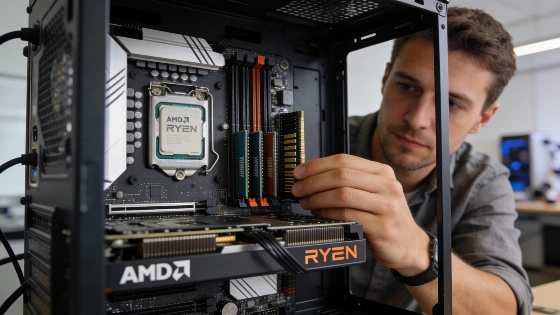
AMD just raised the bar for local AI hardware. The new Ryzen AI Max+ PRO 495 lands with a headline spec that jumps off the page: up to 192 GB of unified LPDDR5X-8533 memory. This memory is shared between the CPU and integrated graphics. For years, memory limits have held back on-device AI. Not anymore.
But memory is only part of the story. The Ryzen AI Max+ PRO 495 uses Zen 5 cores-16 in total, with 32 threads. It can hit 5.2 GHz. TDP is flexible, from 45 to 120 W. The chip includes Radeon 8065S graphics built on RDNA 3.5, with 40 compute units. That's serious power for both graphics and AI. There's also a dedicated NPU based on XDNA 2. It delivers up to 55 TOPS. This chip is built for heavy AI inference and development.
Compared to the previous Ryzen AI Max 300 series, the new Ryzen AI Max+ PRO 400 series increases unified memory capacity from 128 GB to 192 GB, and the available GPU memory pool grows from 96 GB to 160 GB.
Unified memory changes the game for local AI
The unified memory system is the real breakthrough. AMD says the platform can give the integrated GPU up to 160 GB of video memory. That's far more than most desktops or laptops. Now, AI models that once needed the cloud can run locally. AMD claims the processor can handle models with over 300 billion parameters at 4-bit quantization. All of this happens on the user's own machine.
Memory bandwidth is strong too. LPDDR5X-8533 delivers up to 273 GB/s. A Club386 performance analysis shows this is a 6.5% jump over the previous Ryzen AI Max+ PRO 395, which topped out at 256 GB/s. The shared memory pool lets developers and professionals run, train, and test large AI models, image generation, and inference right on their own hardware. No more waiting on the cloud. No more privacy worries. No surprise bills.
Built for developers and professionals
AMD is putting the Ryzen AI Max+ PRO 495 at the top of its Ryzen AI Max PRO 400 series. The target is clear: enterprise and corporate local AI systems. ChosunBiz reports the chip is made for both Windows and Linux. That means wide compatibility for developers and professionals.
This processor isn't just for laptops. It's also meant for desktops, compact workstations, and pro mobile computers. AMD has already launched the Ryzen AI Halo Developer Platform. This small system comes with the full 192 GB memory, a 2 TB SSD, 10-gigabit Ethernet, and Wi-Fi 7. It can run at up to 120 W TDP.
Following the announcement, mini desktop systems featuring the Ryzen AI Max+ PRO 495 have been introduced by Acemagic, GMKtek, and Framework, with configurations supporting up to 192 GB of unified memory.
Support for both Windows 11 and Linux makes this platform attractive for developers and enterprises. They can build, test, and deploy AI solutions without always relying on outside infrastructure. The system is flexible. It fits many AI development and deployment needs.
Ryzen AI Max+ PRO 495 isn't just about chasing benchmarks. AMD is changing what's possible for local AI hardware. With huge memory and strong AI acceleration in one chip, developers and professionals get new tools. They can push on-device AI further than before. This is a clear shift. Users can now run massive AI models locally. The bar for professional AI hardware just moved up.