Nvidia says Vera's memory bandwidth could matter more as AI agents evolve
Ian Finder says Nvidia did not predict the agentic AI surge when Vera's development began four years ago. He argues the CPU's memory bandwidth may become more valuable as agent workloads mature.
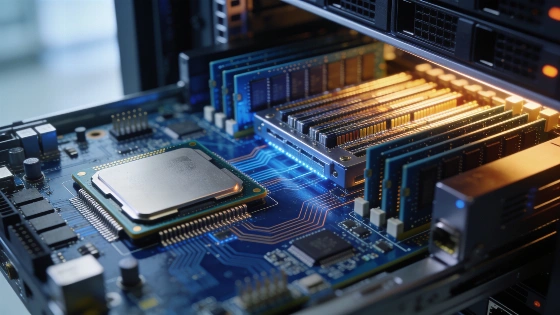
A coding agent can spend much of a task running model inference on a GPU, then shift into CPU-heavy compiling and testing. That shift helps explain Nvidia's argument that its Vera CPU's memory bandwidth could matter more as agent systems evolve. Vera combines 88 Nvidia-designed Olympus cores with LPDDR5X memory, and Nvidia lists peak single-socket memory bandwidth of up to 1.2 TB/s. Its comparison lists up to 512 GB/s for comparable Grace configurations, which use 72 Arm Neoverse V2 cores. The figures and architecture are detailed in Nvidia's Vera platform documentation.
The claim comes with a caveat: Vera was not designed around a forecast of today's agentic AI wave. Ian Finder, who leads Nvidia's data center CPU business, told Tom's Hardware Premium at SC26 that the idea the company had foreseen the agentic moment four years earlier was "absurd."
"Am I going to sit here and tell you that we have this magic crystal ball around the agentic moment? That would be absurd, right?" Finder said. He added that Nvidia's record reflects "design intuition."
Why agents put pressure on CPUs
In Finder's coding-agent example, a model makes small tool calls to locate and read files, with the GPU doing most of the work during inference. Compilation and testing can then become more CPU-bound, while the GPU takes on another task. The challenge is starting agent sandboxes quickly enough that neither processor sits idle. Nvidia's Vera whitepaper describes the CPU's design as combining Olympus cores and LPDDR5X with its Scalable Coherency Fabric and NVLink-C2C, with up to 1.8 TB/s of coherent CPU-to-GPU bandwidth. These are architectural maximums, not agent workload benchmarks, as outlined in the Vera CPU whitepaper.
Finder said teams will pack multiple environments together and subscribe the socket rather than leave the CPU waiting. Startups including Daytona and E2B are working on ways to open and close agent sandboxes in milliseconds, according to the source material. Serving more agents also increases pressure on memory bandwidth.
That is where Nvidia says Vera has room to benefit as software and workloads develop. Nvidia's system-health documentation lists a STREAM Triad result of 1,045 GB/s for a one-socket Vera configuration using 88 threads and 768 GB of locally attached memory, with DRAM running at 9,600 MT/s. Its two-socket reference result is 2,088 GB/s across 176 threads and 1.5 TB of memory; the aggregate two-socket figure is not a single-socket result. The documentation also identifies NUMA placement, CPU affinity, kernel version, page size and memory capacity as factors affecting measured bandwidth. A separate software-tuning report described a nearly 39% gain in a DGEMM test with code tuned for Vera's Olympus cores; generic Arm code did not fully use the chip's execution resources.
Vera's design grows out of Nvidia's earlier work pairing CPUs with accelerators, beginning with Grace. Finder described the approach as starting with a basic question: what CPU can keep the accelerator fed? Grace brought Nvidia's Scalable Coherency Fabric memory system; Vera extends that system and adds the Olympus core microarchitecture. Nvidia lists Vera configurations with 256-768 GB of LPDDR5X and support for up to 1.5 TB through SOCAMM modules.
Finder called the design "opinionated." He said the team prioritized single-thread performance and concurrency, then pursued instruction-level performance rather than relying on frequency. He also pointed to loaded memory latency and bandwidth, describing the design as a clean-sheet effort outside conventional dollar-per-core economics.
Vera's trade-offs and Nvidia's next CPU
The company did not claim it had predicted the current agentic wave. Finder said the team had begun seeing tool calling and understood the broad requirements of a head node. That distinction matters: Nvidia's case rests on design choices that may suit evolving workloads, not on proof that Vera was purpose-built for today's agents.
Vera does not lead every workload, and AMD's EPYC Venice has reclaimed top spots in several benchmarks cited in the source. Nvidia's argument is that memory bandwidth may become more consequential as agent systems make better use of available compute. The company has announced Rosa as Vera's follow-up, with the Rigel microarchitecture.
Topics: