
Managed file transfer now defines secure data compliance
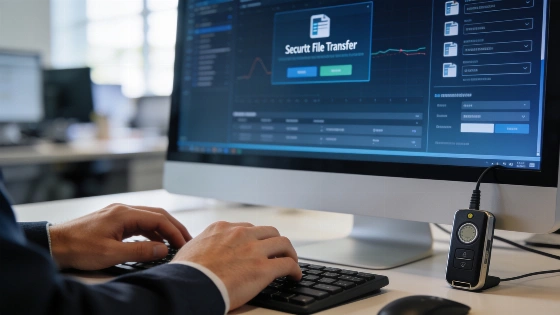
Every file sent inside a company can trigger a compliance problem or a security breach. That's the reality for anyone handling sensitive data. FTP and other old protocols no longer cut it. Managed file transfer (MFT) is now the only way to get real security, full audit trails, and meet strict regulatory demands.
For regulated data, three core requirements are repeated: encryption, identification/authentication, and auditable logging. The MFT approach is presented as a way to bring these functions together in a single platform.
Regulators are forcing the change. Healthcare, finance, government, and retail all face their own rules-HIPAA, FISMA, GLBA, PCI DSS. Each one sets strict controls for moving, accessing, and tracking data. Encryption is just the start. Now, companies need tight access controls, multi-factor authentication, audit logs that can't be changed, and real-time monitoring. Anything less is an open door for hackers and fines. Compliance checklists now demand logs for every login, upload, download, permission change, file deletion, admin action, and failed transfer. Regulators want proof, not promises. PacGenesis spells out these requirements in detail for regulated businesses in its compliance recommendations.
MFT platforms are the only real answer. They don't just patch old protocols. They bring security, compliance, automation, and management into one place. Data is encrypted at rest and in transit. Access is locked down to the minimum needed. Key rotation happens automatically. Audit trails are detailed and can't be changed. For companies that must prove compliance, these are not extras. They are must-haves. Coviant Software points out that MFT platforms combine encryption, authentication, and audit logging in one system. That's what regulated industries need.
Comparison matrices of MFT solutions indicate that in the market, security and compliance are often tied to a set of controls such as SOC 2, ISO 27001, GDPR, HIPAA, PCI DSS, SSO/SAML, and 2FA, reflecting a shift from 'transfer protocol' to 'access management and audit platform'.
Speed and uptime matter too. MFT platforms are built for big data loads, low lag, and high bandwidth. They keep up as business grows. Automated backup, versioning, and fast restore mean that even if data is lost, business keeps moving.
Zero trust is now the rule. No one gets a free pass inside the network. Every user, device, and app must prove itself every time. Micro-segmentation and identity-based controls stop attackers from moving sideways or gaining more access. MFT platforms with zero trust-like Kiteworks-watch for odd behavior and cut off access right away if something looks wrong. That's real defense.
Kiteworks leads here. Its Private Data Network uses end-to-end AES-256 encryption and TLS 1.3 for data in transit. Permissions match company roles and compliance needs exactly. Audit logs are detailed and can't be changed, making reports and investigations simple. It fits with existing business tools, so security doesn't slow down work. Kiteworks says every action is logged with the user, action, file, policy, and result. All writes and transfers are recorded in a tamper-proof audit trail.
For companies facing HIPAA, GDPR, PCI DSS, and more, Kiteworks gives one platform that turns file transfer from a compliance headache into a business advantage. Its layered defenses, workflow automation, and central management make it the clear choice for any enterprise that can't risk a breach or a fine.
The bottom line is simple. Old file transfer protocols belong to a time with fewer rules and fewer threats. Now, every file move is watched. Every breach is expensive. Only managed file transfer-especially with zero trust and deep compliance-gives the security, uptime, and audit trails that modern companies need. Anything less is a gamble no serious business should take.