Five AI Prompts Stage Karwa Chauth Couple Portraits
Karwa Chauth falls on Thursday, 29 October 2026, on Kartik Krishna Paksha Chaturthi. Amar Ujala's calendar listing gives the date according to the rule of udaya tithi. Published panchang calculations place the tithi from 1:06 a.m. to 10:09 p.m. that day. Those are tithi timings, not a universal moonrise time: chandrodaya varies by city.
With a reference photo, AI can add a crimson saree and rooftop lights, then frame a Karwa Chauth ritual. It cannot guarantee that faces or hands will stay accurate. These five prompts for ChatGPT and Google Gemini offer different portrait ideas for 2026, while asking the tools to preserve the people in the uploaded photo as closely as possible.
A clear reference image gives the tool a better starting point. Directions can specify clothing and pose, then set the lighting and background. The result may still change facial features or misplace objects. ChatGPT Images can create images and edit uploads through written instructions or a selected area. OpenAI cautions that selections may be imprecise, and edits can spill beyond them. Check the full image before using or sharing it. Get another person's consent before uploading or publishing a photo that includes them.
Choose a scene before generating
The options include a rooftop portrait and a close view of the chhalni ritual. One prompt edits an existing couple photo while asking the tool to retain the original pose. Another depicts a woman performing a water ritual. Choose a composition that suits the photo you plan to upload. Treat requests to preserve identity as instructions, not guarantees. Inspect faces and hands first, then check the jewellery and ritual objects.
Red saree rooftop portrait
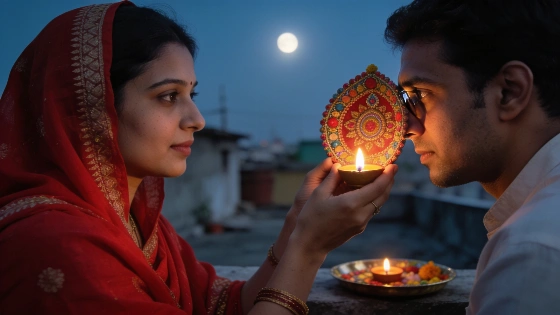
Create a photorealistic Karwa Chauth couple portrait at night on a decorated rooftop. Use the uploaded reference photo to preserve both adults' facial identities and natural appearance as closely as possible. Dress the woman in a deep crimson saree with gold embroidery. Add gold jewellery, red bangles and mehndi. Style her dark wavy hair half-up with jasmine flowers. She holds an ornate chhalni and a brass puja thali with a diya and flowers, smiling gently at her husband. He wears a white shirt with black trousers and looks at her affectionately. Add a crescent moon above the rooftop. Include warm lights and lanterns around them. Keep the skin and fabric realistic, with natural-looking hands. Use soft moonlight alongside warm available light. Vertical 3:4 composition. Avoid distorted fingers and artificial-looking skin. Keep expressions natural. Do not add text or watermarks.
Husband seen through the chhalni
Create a photorealistic Karwa Chauth night portrait using the uploaded reference to preserve the husband's facial identity as closely as possible. Frame the scene over the woman's right shoulder, keeping her face outside the frame. Show her red embroidered saree and her mehndi-covered hand with red-and-gold bangles as she holds an ornate chhalni. Her husband stands to the left, his face clearly visible through the sieve mesh. He wears a white shirt and gives a natural, gentle smile. Place a small diya near the lower edge of the sieve. Show a bright moon above him, with rooftop lights softly blurred in the background. Keep the hands and sieve realistic. Use vertical 3:4 framing. Avoid extra fingers and blurry facial features. Keep objects in their proper places. Do not add text or watermarks.
Yellow saree couple portrait
Create a photorealistic Karwa Chauth couple portrait on a rooftop at night. Use the uploaded reference to preserve both people's facial identities and natural expressions as closely as possible. The woman wears a yellow silk saree with a red-and-gold border. Add gold jewellery and mehndi. She stands beside her husband and holds his arm; he wears a dark navy-maroon kurta. Decorate the railing with marigold garlands and warm fairy lights. Place a brass puja thali nearby, with a lota and chhalni on the ledge. Use natural colours and realistic fabric. Keep the skin realistic, with gentle moonlight mixed with warm available light. Vertical 3:4 composition. Avoid altered faces and unnatural hands. Keep all ritual objects in the image. Do not add text or watermarks.
Keep the original pose
Edit the uploaded photograph into a photorealistic Karwa Chauth portrait of the same adult couple. Preserve their facial identities and skin tones as closely as possible. Keep their apparent ages unchanged. Retain their body posture and standing positions. Preserve hand placement and the distance between them. Keep the original camera angle. Dress the woman in a crimson saree with gold embroidery. Add traditional jewellery, red-and-gold bangles and mehndi. Place jasmine flowers in her dark wavy hair. Dress the man in a white button-down shirt with rolled sleeves and black trousers. Change the background to a rooftop at night, with a crescent moon and lanterns. Add warm lights. Keep expressions natural and skin texture realistic. Avoid reshaping faces or changing the pose. Do not over-smooth the image or distort hands. Do not add text or watermarks.
Red saree water ritual
Create a photorealistic Karwa Chauth ritual portrait of the same adult Indian woman shown in the uploaded reference. Preserve her facial identity and skin tone as closely as possible. Keep her natural appearance. She wears an ornate red saree with gold embroidery and traditional gold jewellery. Add a jasmine gajra to her dark hair. On a rooftop at night, she raises a decorated karwa pot with both hands and pours water in a calm, natural ritual gesture. Keep the pot and hands clearly visible. Show the water stream clearly, with anatomically realistic hands. Use soft moonlight alongside warm available light. Keep shadows and fabric realistic. Vertical 3:4 composition. Avoid extra fingers and an oddly shaped pot. Keep the water stream natural. Do not add text or watermarks.
How to use and check the prompts
Open ChatGPT or Google Gemini and upload a clear reference photograph. For a couple portrait, choose an image where both people are visible. Use separate references only if the tool supports them. Copy one complete prompt into the chat and generate the image. OpenAI has retired its official DALL·E GPT; its current image guidance directs users to ChatGPT Images for creating and editing images. Google's Gemini Apps guidelines cover safe use of the app.
Inspect the faces first. Check the hands next, then review the jewellery and saree details. Make sure the ritual objects are present. If one element is wrong, request a targeted correction and ask the tool to leave the rest of the image unchanged. Editing tools can affect areas beyond the selection, so review the whole picture before saving or sharing it. A reference photo can guide identity and pose, but it cannot guarantee an exact match.
For Karwa Chauth captions that mention moonrise, use the time for the specific city. The tithi's span from 1:06 a.m. to 10:09 p.m. is not a moonrise schedule. Amar Ujala's 2026 calendar lists the festival date as 29 October.