Trusta Adds SSD-Based KV Cache Offloading to Its AI Toolkit
At SC26 in Chicago, Trusta is showing an upgraded AI Scaler Toolkit that moves vLLM's KV cache beyond GPU memory. Its Strata results vary by input length and conversation pattern.
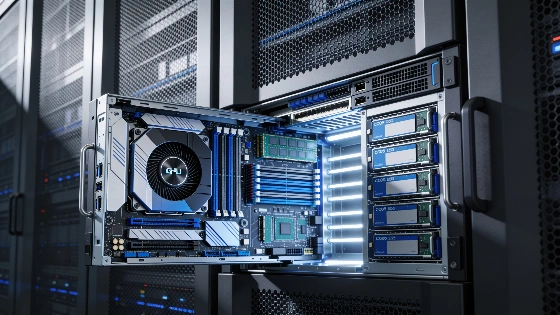
Long prompts can push an inference server's KV cache beyond GPU memory. When cached context is evicted, it must be recomputed before the model can continue, adding wait time.
Trusta's upgraded AI Scaler Toolkit works around that limit by offloading vLLM's KV cache. Active requests stay in GPU memory, while DRAM serves as a faster cache. Trusta PCIe Gen5 enterprise SSDs provide a larger, lower-cost tier that persists across restarts. Saved conversations can then resume without rebuilding their cache from scratch. vLLM's offloading configuration supports CPU as a primary tier, with storage or network tiers behind it; GPU transfers are routed through the CPU tier. Offloading must be configured: vLLM's documented default is no KV-cache offload. Its native worker registers GPU cache tensors and allocates pinned CPU tensors for cache data, while tiering policies can determine which blocks remain in faster memory.
For storage transfers, vLLM documents an asynchronous disk-offload backend that pipelines GPU data transfers with storage reads and writes. The design uses separate coordinator threads for loading and storing cache data, with direct I/O enabled by default. See the vLLM cache configuration and its asynchronous disk backend.
Performance depends on the workload
Trusta says its internal testing found that long documents can be reloaded from SSD instead of recomputed. The company also says the saved cache can let conversations resume after a server restart. These are vendor-reported results, not independent measurements. Cache retrieval performance depends on storage latency, PCIe bandwidth, cache locality, token count, model architecture and the amount of data transferred.
The toolkit also includes the Strata inference engine with Intel AMX acceleration on Intel Xeon processors. Trusta's November 2026 tests compared its AMX-enabled version with upstream Strata v0.2.11 on an Intel Xeon w5-3535X system with one Nvidia RTX 6000 Ada GPU running a Mixture-of-Experts model. The tests measured only prefill, the stage that processes an incoming prompt. Trusta described the results in its product announcement.
For a single input of about 8K tokens, Trusta reported an improvement of approximately 11%. In multi-turn conversations with about 4K new tokens per turn, the reported gain reached approximately 25%. Inputs above about 12K tokens showed no significant difference. Each test ran at least three times, with median results reported; Trusta says performance varies with hardware, model, and input length.
Toolkit and hardware on display at SC26
The software supports vLLM, llama.cpp, and Strata, with one-click installation and a shared interface for allocating resources and tuning parameters. Trusta is also showing PCIe Gen5 enterprise SSDs and DDR5 R-DIMMs at SuperComputing 2026, which runs November 17-19 at McCormick Place West, Exhibit Halls in Chicago.
The TD7P51 ECO / T7P5 SSD line offers capacities up to 15.36TB in U.2, E1.S, and E3.S form factors, with endurance up to 3 DWPD. Trusta says Flexible Data Placement improves storage efficiency and extends drive lifespan. The drives consume less than 20W, and the company claims 1.7x better energy efficiency than comparable products.
Trusta's DDR5 R-DIMMs reach speeds up to 6,400MT/s and capacities up to 128GB per module. Their built-in ECC detects and corrects data errors. The company's infrastructure showcase sits alongside a planned Chennai AI data-center project previously covered by NerdsMagazine.
SC26's exhibition is scheduled to run through November 19 at booth #7214.
Topics: