
AI Outages Expose the Seven Day Risk for Data Leaders
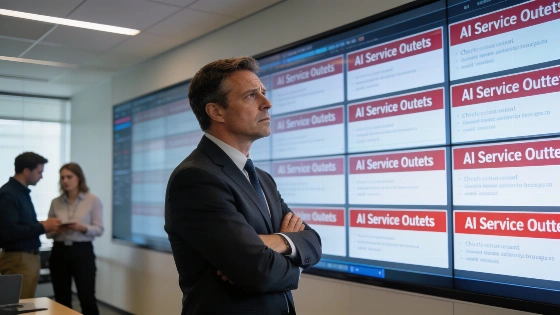
September 3 did not go as planned for enterprise tech teams. Three major AI platforms-OpenAI's ChatGPT, Anthropic's Claude, and xAI's Grok-went down within hours. Each blamed a different technical glitch. The result was chaos for businesses that depend on these tools. Many scrambled to keep operations running. Some failed.
In the wake of the September 3 outages, OpenAI, Anthropic, and xAI all issued public updates, but only a minority of enterprise leaders reported having a clear map of their AI dependencies.
This was not a minor blip. The triple outage hit every Chief Data Officer who thought their AI stack was safe. Suddenly, the real question was clear. If your main AI goes down, do you know which workflows stop? Who fixes what? What hidden links could break your business?
The seven day question: how deep is your AI lock-in?
"The Calculus of AI Sovereignty," a survey by IBM Institute for Business Value and Oxford Economics, asked 1,000 senior executives about their AI risks. Only 9% said they truly understand their AI dependencies. The rest? Most are in the dark. The survey found 71% say switching their main AI vendor or model would be hard. Even more-81%-admit a seven-day outage would be severe or critical. For many, that means business stops. The IBM UK Newsroom report shows these worries are everywhere among data leaders.
This is the seven-day question. If your main AI provider vanished for a week, what would keep working? For most, the answer is bleak. IBM puts it plainly. Knowing where your data sits is not enough. Real digital sovereignty means control across five layers: data, AI, software operations, infrastructure, and technology. The real test is simple. Can you move your data, swap models, and shift workloads without being trapped by one vendor?
Control, compliance, and the price of waiting
IBM emphasizes that true AI sovereignty is not just about data location, but about maintaining control over data, AI models, software, infrastructure, and the ability to switch providers without vendor lock-in.
For CDOs, the warning is blunt. Blind trust in AI vendors is over. The next outage is not a theory. It is a real risk. Only those who can map, control, and, if needed, break apart their AI stack will keep their business running when the next seven-day test comes. Anything less is a bet against your own future.